> ## Documentation Index
> Fetch the complete documentation index at: https://kw.hellenictechnologies.com/llms.txt
> Use this file to discover all available pages before exploring further.
# Server-Side Tracking Agency — 200+ Implementations Worldwide
> We have completed over 200 server-side tracking implementations for businesses of every size, in every country. Recover lost conversions, fix attribution, and become GDPR-compliant — regardless of where you operate or how large your business is.
We have deployed server-side tracking for startups, mid-market companies, and enterprise brands across Europe, the Middle East, and beyond.
The average business running browser-side tracking loses 20–40% of its conversion data to ad blockers, iOS restrictions, and browser privacy changes. We close that gap.
We work with businesses of all sizes from anywhere in the world. Our process is fully remote and has been tested across 30+ markets.
***
## What is server-side tracking — and why does your business need it?
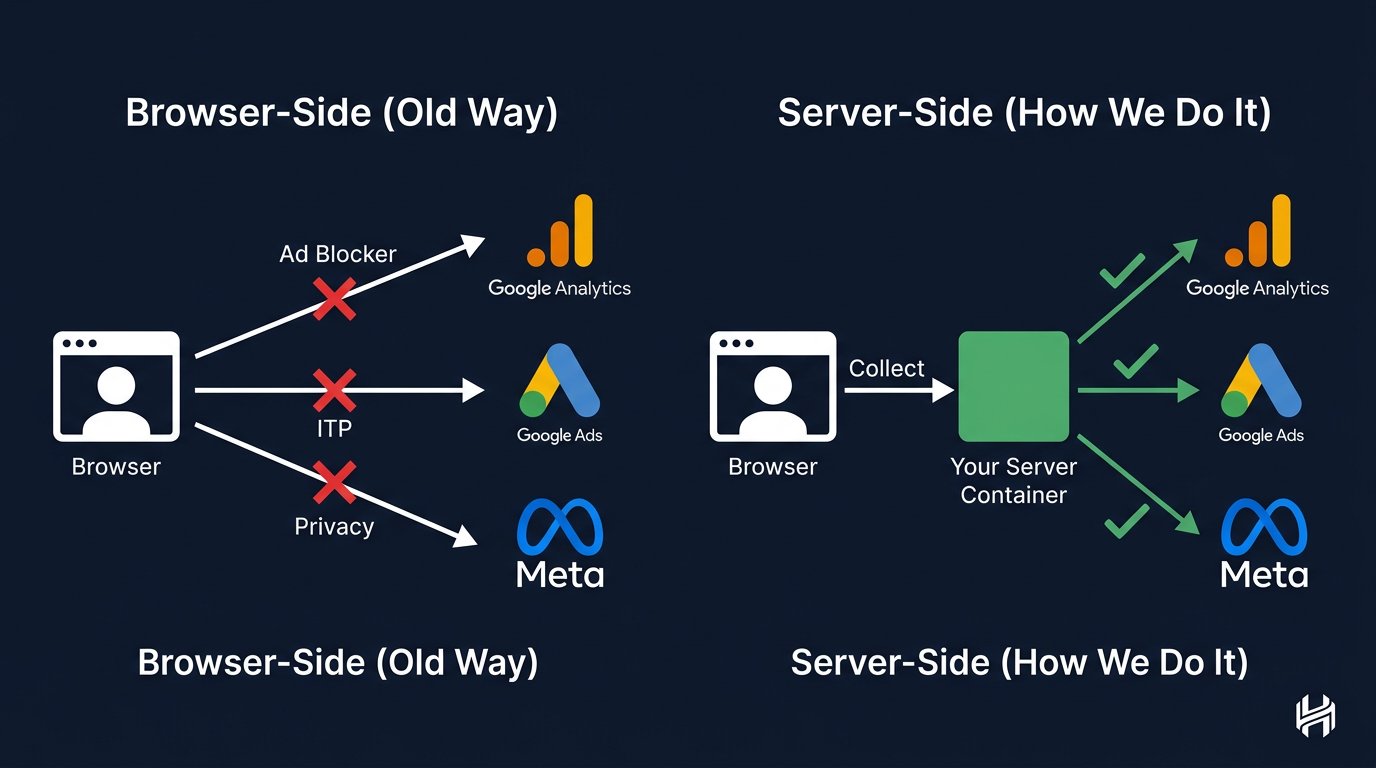
Server-side tracking (SST) moves your measurement infrastructure from the visitor's browser onto a secure server you control. Instead of firing tags inside the browser — where ad blockers, iOS 14+ privacy restrictions, and ITP intercept them — your analytics and ad platform events are processed on the server and forwarded directly.
The result: you stop losing data you are already paying to collect.
> **If you are running Google Ads or Meta campaigns today, you are almost certainly making budget decisions on 60–80% of your actual conversion data.** The other 20–40% is being silently blocked before it ever reaches your ad platform.
***
## Why browser-side tracking is broken (and cannot be fixed)
This is not a configuration problem. It is a structural one. Three forces are compounding every year:
| Problem | What happens | What it costs you |
| -------------------------------- | ------------------------------------------- | ---------------------------------------- |
| **Ad blockers** | Tags blocked before they fire | Conversions silently lost |
| **ITP / Safari privacy** | JavaScript cookies capped at 7 days | Return visitors misattributed as new |
| **iOS 14+ signal loss** | Platform events degraded at source | ROAS overstated, campaigns mis-optimised |
| **Third-party cookie phase-out** | Cross-site tracking increasingly restricted | Attribution breaks across sessions |
There is no patch for this. Patching the existing setup just postpones the problem. The correct answer is rebuilding measurement at the server layer.
***
 ***
## How does server-side tracking work?
Before touching your setup, we analyse your existing tracking to identify every data gap. We quantify the difference between reported conversions and actual business events. Most clients are surprised by how much they are missing.
We deploy your Google Tag Manager server container on Stape — the industry-standard hosting platform for sGTM — on a first-party subdomain of your own domain (e.g. `sst.yourbusiness.com`). Your visitors never see a third-party domain. Everything looks first-party.
We migrate your core tracking tags from browser-side to server-side. GA4 event forwarding, Google Ads conversion tracking, and Meta Conversions API (CAPI) are all configured at the server layer — invisible to ad blockers and immune to browser restrictions.
Once events reach the server, we enrich them with data that is impossible to collect in the browser — hashed customer IDs, CRM attributes, transaction values from your order system. This improves match rates and smart bidding quality directly.
Consent signals from your CMP (Cookiebot, OneTrust, Axeptio, or custom) are propagated from browser to server. Your full pipeline is GDPR-compliant — not just the frontend banner. We implement this correctly for Article 7 and ePrivacy compliance.
Every event is verified end-to-end before launch. Post-launch, we configure data stream health monitoring and alerting — so you know immediately if something breaks. You are not left guessing.
***
## What you actually get from this
Google Smart Bidding and Meta Advantage+ work on signal quality. Recovering lost events means your algorithms optimise on real data — CPAs drop, ROAS improves.
Data is processed on your server before being forwarded to any third party. You control the pipeline. This is the correct architecture for a Data Processing Agreement — not just a banner.
Server-set HTTP cookies are not subject to ITP's 7-day cap. Return visitors, multi-session journeys, and post-iOS-update conversions all attribute correctly.
When tracking logic moves server-side, the browser tag count drops dramatically. Pages load faster, Core Web Vitals improve, and your SEO benefits indirectly.
Analytics figures that match your payment processor, CRM, and operations data. No more explaining a 35% discrepancy to the board.
Browser privacy restrictions will only increase. Server-side tracking is the architecture that survives — and thrives — in the post-cookie environment.
***
## Do I even need server-side tracking?
Not anymore. GA4 and Google Ads conversion tags installed via GTM are browser-side by default. They are intercepted by ad blockers (used by 30–50% of desktop users in many European markets), suppressed by iOS privacy settings, and subject to ITP cookie restrictions on Safari. If you set this up before 2022, the gap between your reported conversions and your actual business results has been widening every month since. Server-side tracking is the only structural fix.
No. We have implemented it for solo e-commerce stores, small B2B lead generation businesses, and enterprise brands with millions in ad spend. The technical setup is the same; the only difference is the event volume. Any business running paid media or relying on analytics for decisions should have server-side infrastructure — the data quality improvement is proportionally the same regardless of size.
Yes. Our entire process is remote. We have completed over 200 server-side tracking implementations for clients in Greece, across Europe, the Middle East, the US, and beyond. We work across time zones, full stop.
Consent mode and server-side tracking solve different problems. Consent mode handles what happens when a user declines cookies — it uses modelled data to fill gaps. Server-side tracking handles what happens when a user accepts cookies but their browser still blocks your tags. You need both. Most businesses who think they are GDPR-compliant with consent mode alone are still losing 15–25% of their conversion data to technical blocking — not privacy choices.
No. Server-side tracking sits between your website and the ad platforms — it is platform-agnostic. We have implemented it on Shopify, WooCommerce, Magento, custom Next.js and React apps, Laravel back-ends, and static sites. The implementation approach adapts; the outcome is the same.
A standard implementation (GA4 + Google Ads + Meta CAPI) takes 5–10 business days from audit to go-live. Complex setups with custom events, CRM enrichment, or multiple platforms may take 2–4 weeks. We have completed over 200 of these — our process is fast because it is systematic.
Implementation is a one-time project. Ongoing Stape hosting is typically €30–80/month depending on event volume (paid directly to Stape). We will give you a fixed-price quote after a brief scoping call — there are no surprises. Start with a free tracking audit to understand your data gap before committing to anything.
The opposite. Server-side tracking gives you more control over personal data flows, not less. With browser-side tracking, data escapes to third-party vendors before you can apply consent logic. With server-side tracking, all data passes through your infrastructure first — you decide what gets forwarded, when, and with what transformations applied. This is the architecture GDPR intended. We implement with full consent mode propagation and document everything for your DPA.
***
## Why Hellenic Technologies
We are not a general digital agency that has added server-side tracking to its service list. This is what we do.
* **200+ SST implementations** completed — across e-commerce, SaaS, B2B lead gen, hospitality, finance, and professional services
* **Every major platform covered** — GA4, Google Ads, Meta CAPI, TikTok Events API, LinkedIn Insight Tag, Pinterest, Criteo
* **Every business size** — from a founder running €500/month in Meta ads to brands spending seven figures annually
* **Every location** — fully remote process, no geographic restrictions
* **Not a template job** — every implementation starts with a measurement audit and is built to your specific event map, CRM setup, and consent framework
We have seen every edge case. We fix problems other agencies leave in place.
***
## What clients say
> *"Our Meta ROAS improved significantly within the first month after the SST implementation. The team found conversion events we had no idea we were missing."*
> — E-commerce brand, 3,000+ orders/month
> *"We had three different agencies touch our tracking setup over two years. Hellenic Technologies was the first to actually audit what we had and explain what was broken before proposing anything."*
> — B2B SaaS, lead generation focus
> *"Fully remote, fast turnaround, and they explained everything clearly. I didn't expect the process to be this smooth given we're not based in Greece."*
> — Retail business, UAE
***
## Who this is built for
If you are spending on paid media and relying on browser-side conversion tracking, your bidding algorithms are working with degraded data. SST recovers the lost signal and improves smart bidding performance immediately. This is the highest-ROI tracking investment a paid media team can make.
Form submissions, phone calls, and chatbot leads are particularly vulnerable to ad blocker interference. Every untracked lead is also misattributed — which means your best-performing campaigns may look mediocre. Server-side forwarding ensures every qualified lead is counted, attributed, and fed back to your bidding platform.
Server-side tagging gives you architectural control over data flows. It is the correct foundation for GDPR Article 7 compliance at the measurement layer — not just a frontend consent banner that feels compliant but leaves data escaping to third parties.
If your marketing data feeds into board dashboards or investor reporting, data integrity is non-negotiable. Server-side infrastructure is the standard for organisations where the numbers need to be right — not approximately right.
***
Every engagement starts with a tracking audit — a structured review of your current setup that identifies exactly where data is being lost and what it is costing you in wasted spend and missed optimisation. Most audits complete within five business days. Start here before committing to anything.
***
## How does server-side tracking work?
Before touching your setup, we analyse your existing tracking to identify every data gap. We quantify the difference between reported conversions and actual business events. Most clients are surprised by how much they are missing.
We deploy your Google Tag Manager server container on Stape — the industry-standard hosting platform for sGTM — on a first-party subdomain of your own domain (e.g. `sst.yourbusiness.com`). Your visitors never see a third-party domain. Everything looks first-party.
We migrate your core tracking tags from browser-side to server-side. GA4 event forwarding, Google Ads conversion tracking, and Meta Conversions API (CAPI) are all configured at the server layer — invisible to ad blockers and immune to browser restrictions.
Once events reach the server, we enrich them with data that is impossible to collect in the browser — hashed customer IDs, CRM attributes, transaction values from your order system. This improves match rates and smart bidding quality directly.
Consent signals from your CMP (Cookiebot, OneTrust, Axeptio, or custom) are propagated from browser to server. Your full pipeline is GDPR-compliant — not just the frontend banner. We implement this correctly for Article 7 and ePrivacy compliance.
Every event is verified end-to-end before launch. Post-launch, we configure data stream health monitoring and alerting — so you know immediately if something breaks. You are not left guessing.
***
## What you actually get from this
Google Smart Bidding and Meta Advantage+ work on signal quality. Recovering lost events means your algorithms optimise on real data — CPAs drop, ROAS improves.
Data is processed on your server before being forwarded to any third party. You control the pipeline. This is the correct architecture for a Data Processing Agreement — not just a banner.
Server-set HTTP cookies are not subject to ITP's 7-day cap. Return visitors, multi-session journeys, and post-iOS-update conversions all attribute correctly.
When tracking logic moves server-side, the browser tag count drops dramatically. Pages load faster, Core Web Vitals improve, and your SEO benefits indirectly.
Analytics figures that match your payment processor, CRM, and operations data. No more explaining a 35% discrepancy to the board.
Browser privacy restrictions will only increase. Server-side tracking is the architecture that survives — and thrives — in the post-cookie environment.
***
## Do I even need server-side tracking?
Not anymore. GA4 and Google Ads conversion tags installed via GTM are browser-side by default. They are intercepted by ad blockers (used by 30–50% of desktop users in many European markets), suppressed by iOS privacy settings, and subject to ITP cookie restrictions on Safari. If you set this up before 2022, the gap between your reported conversions and your actual business results has been widening every month since. Server-side tracking is the only structural fix.
No. We have implemented it for solo e-commerce stores, small B2B lead generation businesses, and enterprise brands with millions in ad spend. The technical setup is the same; the only difference is the event volume. Any business running paid media or relying on analytics for decisions should have server-side infrastructure — the data quality improvement is proportionally the same regardless of size.
Yes. Our entire process is remote. We have completed over 200 server-side tracking implementations for clients in Greece, across Europe, the Middle East, the US, and beyond. We work across time zones, full stop.
Consent mode and server-side tracking solve different problems. Consent mode handles what happens when a user declines cookies — it uses modelled data to fill gaps. Server-side tracking handles what happens when a user accepts cookies but their browser still blocks your tags. You need both. Most businesses who think they are GDPR-compliant with consent mode alone are still losing 15–25% of their conversion data to technical blocking — not privacy choices.
No. Server-side tracking sits between your website and the ad platforms — it is platform-agnostic. We have implemented it on Shopify, WooCommerce, Magento, custom Next.js and React apps, Laravel back-ends, and static sites. The implementation approach adapts; the outcome is the same.
A standard implementation (GA4 + Google Ads + Meta CAPI) takes 5–10 business days from audit to go-live. Complex setups with custom events, CRM enrichment, or multiple platforms may take 2–4 weeks. We have completed over 200 of these — our process is fast because it is systematic.
Implementation is a one-time project. Ongoing Stape hosting is typically €30–80/month depending on event volume (paid directly to Stape). We will give you a fixed-price quote after a brief scoping call — there are no surprises. Start with a free tracking audit to understand your data gap before committing to anything.
The opposite. Server-side tracking gives you more control over personal data flows, not less. With browser-side tracking, data escapes to third-party vendors before you can apply consent logic. With server-side tracking, all data passes through your infrastructure first — you decide what gets forwarded, when, and with what transformations applied. This is the architecture GDPR intended. We implement with full consent mode propagation and document everything for your DPA.
***
## Why Hellenic Technologies
We are not a general digital agency that has added server-side tracking to its service list. This is what we do.
* **200+ SST implementations** completed — across e-commerce, SaaS, B2B lead gen, hospitality, finance, and professional services
* **Every major platform covered** — GA4, Google Ads, Meta CAPI, TikTok Events API, LinkedIn Insight Tag, Pinterest, Criteo
* **Every business size** — from a founder running €500/month in Meta ads to brands spending seven figures annually
* **Every location** — fully remote process, no geographic restrictions
* **Not a template job** — every implementation starts with a measurement audit and is built to your specific event map, CRM setup, and consent framework
We have seen every edge case. We fix problems other agencies leave in place.
***
## What clients say
> *"Our Meta ROAS improved significantly within the first month after the SST implementation. The team found conversion events we had no idea we were missing."*
> — E-commerce brand, 3,000+ orders/month
> *"We had three different agencies touch our tracking setup over two years. Hellenic Technologies was the first to actually audit what we had and explain what was broken before proposing anything."*
> — B2B SaaS, lead generation focus
> *"Fully remote, fast turnaround, and they explained everything clearly. I didn't expect the process to be this smooth given we're not based in Greece."*
> — Retail business, UAE
***
## Who this is built for
If you are spending on paid media and relying on browser-side conversion tracking, your bidding algorithms are working with degraded data. SST recovers the lost signal and improves smart bidding performance immediately. This is the highest-ROI tracking investment a paid media team can make.
Form submissions, phone calls, and chatbot leads are particularly vulnerable to ad blocker interference. Every untracked lead is also misattributed — which means your best-performing campaigns may look mediocre. Server-side forwarding ensures every qualified lead is counted, attributed, and fed back to your bidding platform.
Server-side tagging gives you architectural control over data flows. It is the correct foundation for GDPR Article 7 compliance at the measurement layer — not just a frontend consent banner that feels compliant but leaves data escaping to third parties.
If your marketing data feeds into board dashboards or investor reporting, data integrity is non-negotiable. Server-side infrastructure is the standard for organisations where the numbers need to be right — not approximately right.
***
Every engagement starts with a tracking audit — a structured review of your current setup that identifies exactly where data is being lost and what it is costing you in wasted spend and missed optimisation. Most audits complete within five business days. Start here before committing to anything.